Is The Synagogue In Cordoba Free?
The Cordoba Synagogue is free only for accredited EU citizens; everyone else pays EUR 0.30. Hours, ticket rules, what the visit includes and the free walks that meet nearby.
In Short
No, not for most visitors. The Sinagoga is a Junta de Andalucia museum, and its rule is a nationality rule, not a day rule: entry is free every open day for accredited EU citizens only. Everyone else, including UK, US and other non-EU visitors, pays EUR 0.30. It opens Tuesday to Sunday from 9:00 to 15:00 and closes on Mondays.
This question sits inside the Cordoba Synagogue guide, which covers the building, its history and how to plan a visit.
Quick Facts
| Question | Answer |
|---|---|
| Is the Synagogue free? | Only for accredited EU citizens; it is a Junta de Andalucia museum |
| What do non-EU visitors pay? | EUR 0.30 |
| Opening hours | Tuesday to Sunday, 9:00 to 15:00 |
| Closing day | Monday |
| Who runs it | Junta de Andalucia (same regime as Medina Azahara, Museo Arqueologico, Bellas Artes) |
| Nearest free walk platform | GuruWalk; the Jewish Quarter Tour in English meets at Puerta de Almodovar |
Is The Synagogue In Cordoba Free?
For accredited EU citizens, yes, on every day the Synagogue is open, and this is a nationality rule rather than a day rule. For everyone else, including UK, US, Canadian and Australian visitors, entry costs EUR 0.30. The building opens Tuesday to Sunday from 9:00 to 15:00, closes on Mondays, and sits in the heart of the Juderia, a few steps from Plaza de Maimonides.
The Sinagoga de Cordoba is run under the Junta de Andalucia's museum network, and that determines everything about its entry pricing. It belongs to the same regime as Medina Azahara, the Museo Arqueologico y Etnologico and the Museo de Bellas Artes: free entry for accredited EU citizens on every open day, and a small fee for everyone else. At EUR 0.30, the Synagogue is the cheapest of the group; Medina Azahara charges non-EU visitors EUR 1.50 at the other end of the scale.
The distinction matters because many visitors assume "free museum in Spain" works the way the municipal Thursday window does, where the city's own museums open their last two hours to everyone. That scheme belongs to the Ayuntamiento and covers the Alcazar de los Reyes Cristianos, the Banos del Alcazar Califal, the Julio Romero de Torres museum, the Museo Taurino and the Centro Flamenco Fosforito. The Synagogue has nothing to do with that scheme. The two regimes never merge, and a visitor who shows up on a Thursday expecting a free window will be asked for EUR 0.30 unless they hold EU accreditation. A free walk meets close to this area, 2 Hour Small-Group English Tour.
Accreditation, in practice, means proving EU citizenship at the desk, normally with a passport or national identity card. The fee side is trivially small, but the principle catches people out in both directions: EU citizens who pay without being asked, and non-EU visitors who arrive expecting a free monument. Neither mistake is expensive here, though the same confusion at Medina Azahara, where the non-EU fee is EUR 1.50 and the site sits outside the city, is more annoying to discover at the gate.
The building itself is small, a single stone prayer hall, and visits are correspondingly short. That shapes the planning advice: the Synagogue is a fifteen to thirty minute stop that slots naturally into a walk through the Juderia, not a half-day destination. Pairing it with the surrounding streets, the Calleja de las Flores and the walls at Puerta de Almodovar, all of which are free public space, is the standard pattern.
For visitors who want the neighbourhood explained rather than just seen, free walking tours are the natural companion, and Free Things To Do In Cordoba exists to make that pairing easy. The walks below, all listed on GuruWalk, are pay what you want, in English, and meet within a few streets of the Synagogue itself.
What Does The Free Part Include?
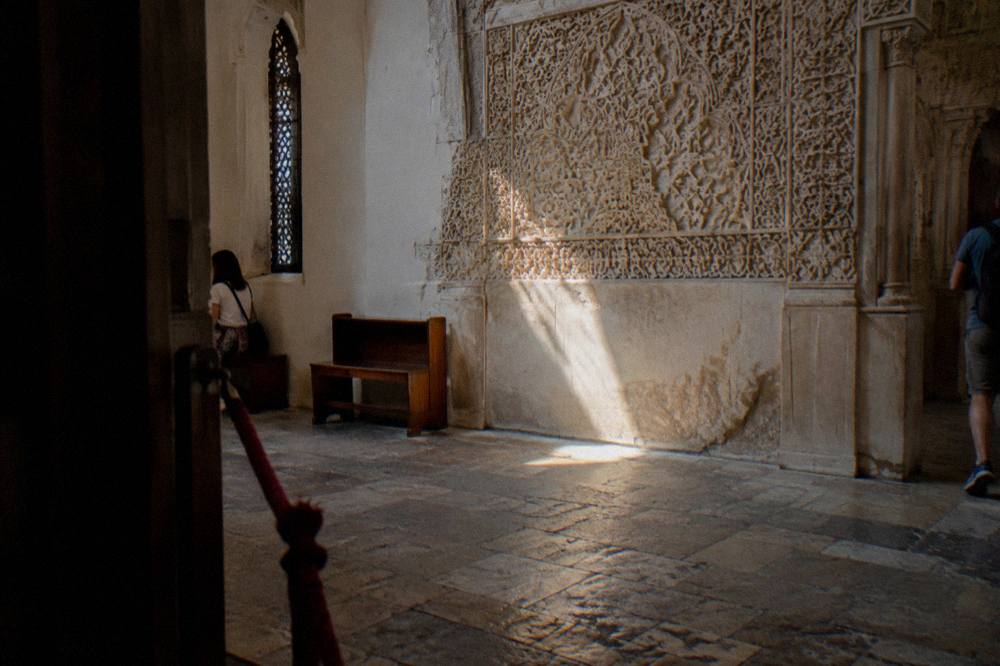
The free entry, for EU citizens, includes the whole monument: the main prayer hall with its Mudejar plasterwork, the women's gallery above, and the small exit onto Calle Judios. There is no separate ticketed wing, no paid add-on inside, and no guided option sold at the door. The visit is self-guided, short, and the entire building is one room stacked on two levels.
This is where the Synagogue is simpler than almost any other paid monument in Cordoba. The Mezquita-Catedral, by contrast, splits its offer into general admission at EUR 15, a bell tower at EUR 4, a night visit at EUR 25 and a Fernandine route at EUR 6, all separate tickets. The Synagogue has no such structure. Whatever your entry status buys, it buys the entire building.
The practical implication for the EU visitor is that "free" here really does mean the full experience, with nothing withheld to an upsell. For the non-EU visitor paying EUR 0.30, the same applies: the thirty cents covers everything there is to see. There is no audioguide counter, no exhibition surcharge and no photography fee recorded in the fact base for this monument.
What the free part does not include is anything outside the door. The Juderia's streets, the Calleja de las Flores, Plaza de Maimonides and Plaza de Judios are free public space in their own right, available around the clock, and need no ticket of any kind. The Synagogue is the one walled, timed, staffed stop in an otherwise open-air neighbourhood, which is why most visitors treat it as a single anchor point on a walking route rather than a destination in itself.
The interior is deliberately austere and small, and visits are naturally brief. That brevity is worth knowing in advance, because the queueing space on Calle Judios is narrow and the building caps how many people can be inside comfortably at once. Nothing in the fact base gives a timed-entry system or a booking requirement, so entry runs on the ordinary museum model: walk up, show accreditation or pay the fee, go in.
What Do You Still Have To Pay For?
If you are not an accredited EU citizen, the only payment is the EUR 0.30 entry fee, and nothing else inside costs money. There is no tower, no night visit and no separate route ticket at the Synagogue, unlike the Mezquita-Catedral complex. The things visitors commonly bundle with the trip, such as Palacio de Viana's patios at EUR 8.50 or the Torre de la Calahorra at EUR 4.50, are separate attractions with their own pricing.
It helps to see the Synagogue's cost structure against its neighbours in the Juderia and the streets immediately around it. The table below sets out what is free, what is conditional and what is paid within a short walk of the door, with entry figures in euros where they apply.
| Attraction near the Synagogue | Status | Condition or price |
|---|---|---|
| Sinagoga de Cordoba | Conditional | Free for accredited EU citizens; EUR 0.30 for everyone else |
| Juderia streets and Calleja de las Flores | Free | Public space |
| Plaza de Maimonides y Plaza de Judios | Free | Public space |
| Murallas and Puerta de Almodovar | Free | Public space |
| Casa Andalusi | Unresolved | No price or free rule published; do not rely on either |
| Casa de Sefarad | Unresolved | No price or free rule published; do not rely on either |
| Palacio de Viana | Paid | EUR 8.50 for the patios; no free slot found |
| Mezquita-Catedral | Conditional | Free slot Monday to Saturday 8:30 to 9:30, individual visitors only; EUR 15 otherwise |
Two of those Juderia names deserve a warning. Casa Andalusí and Casa de Sefarad, the two house-museums most often listed alongside the Synagogue in guidebook itineraries, have no verified price or free rule in the fact base. This site does not publish an entry claim for either: they may charge, they may not, and the honest advice is to check at the door rather than plan around an assumption. The same caution applies to the Museo Diocesano de Bellas Artes, whose listing suggests visits need an appointment.
The Mezquita comparison in the table is not incidental, because most Synagogue visits happen inside a day that also takes in the Mezquita-Catedral. The two buildings sit a few minutes apart, but their free rules could not be more different. The Mezquita's free visit is a 60-minute early slot, Monday to Saturday 8:30 to 9:30, last entry 9:20, for individual visitors only, with no groups and none of the paid extras included. The Synagogue's free rule is about who you are, not when you come. Confusing the two is the single most common planning error in the Juderia.
From 1 January 2027 the Mezquita also starts optional official guided visits, sold at an increase over the normal ticket, with the price not yet published. That change affects the Mezquita, not the Synagogue, and there is no equivalent guided product at the Synagogue in the fact base.
When Is The Free Option Available?
The free entry for EU citizens is available on every open day, with no special window, no Thursday scheme and no advance booking rule recorded. The Synagogue opens Tuesday to Sunday from 9:00 to 15:00 and is closed on Mondays. Unlike the municipal museums, there is no last-two-hours free window, because the free rule here is nationality-based and applies all day.
The Tuesday to Sunday, 9:00 to 15:00 schedule is the frame to plan around. The 15:00 close is earlier than many visitors expect, and it means the Synagogue is strictly a morning-to-early-afternoon stop. An itinerary that leaves the Juderia for late afternoon will find the door shut regardless of citizenship or fee.
The Monday closure mirrors the wider museum pattern in the city: the municipal museums also close on Mondays, as do 1 January and 25 December across that network. For the Junta-run sites the fact base lists the Sinagoga's days explicitly without a separate holiday schedule, so the safe assumption is the weekly pattern plus national closures, confirmed at the desk or on the Junta's cultural agenda pages before a holiday visit.
One recent fact is worth knowing: the Synagogue was closed for restoration from 13 to 24 July 2026, a past and completed closure, but a reminder that this small building does periodically shut for conservation work. If a Cordoba trip lands near a Spanish public holiday or in midsummer, a quick check of the Junta's agenda before walking over is prudent.
The contrast with the city's other free schemes, again, is the thing to hold on to. The municipal Thursday window runs 18:00 to 20:15 in winter and 12:00 to 14:15 in summer, in the last two hours of public access, until capacity. The Mezquita free slot runs 8:30 to 9:30 in the morning. The Synagogue runs neither: its free option is simply there, all day, every open day, for the right passports. That makes it one of the least conditional free things in Cordoba, provided the nationality condition is met.
For non-EU visitors the timing question is even simpler. EUR 0.30 is not a budget decision, so the only real constraint is the opening schedule and the Monday closure. Plan the Juderia walk for Tuesday through Sunday, arrive before mid-afternoon, and the fee is the only formality.
Where Does The Free Visit Start?
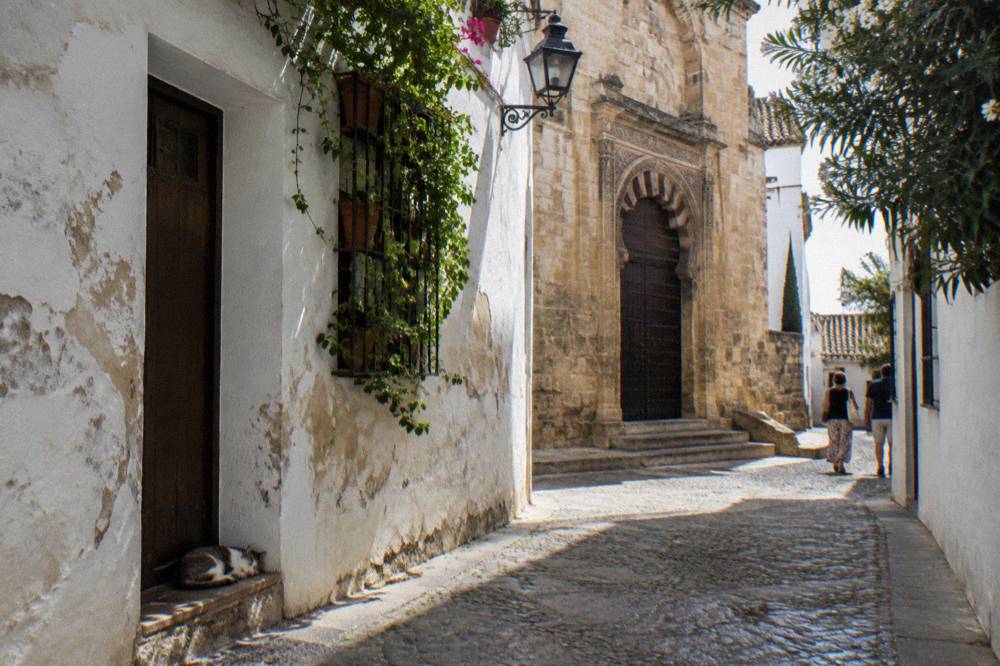
The entrance is on Calle Judios, the narrow street that runs through the Juderia between Plaza de Maimonides and the heart of the old Jewish quarter, with the door marked at the Synagogue itself. There is no separate visitor centre, no shuttle and no offsite ticket desk: accreditation is shown and the fee is paid at the monument's own entrance.
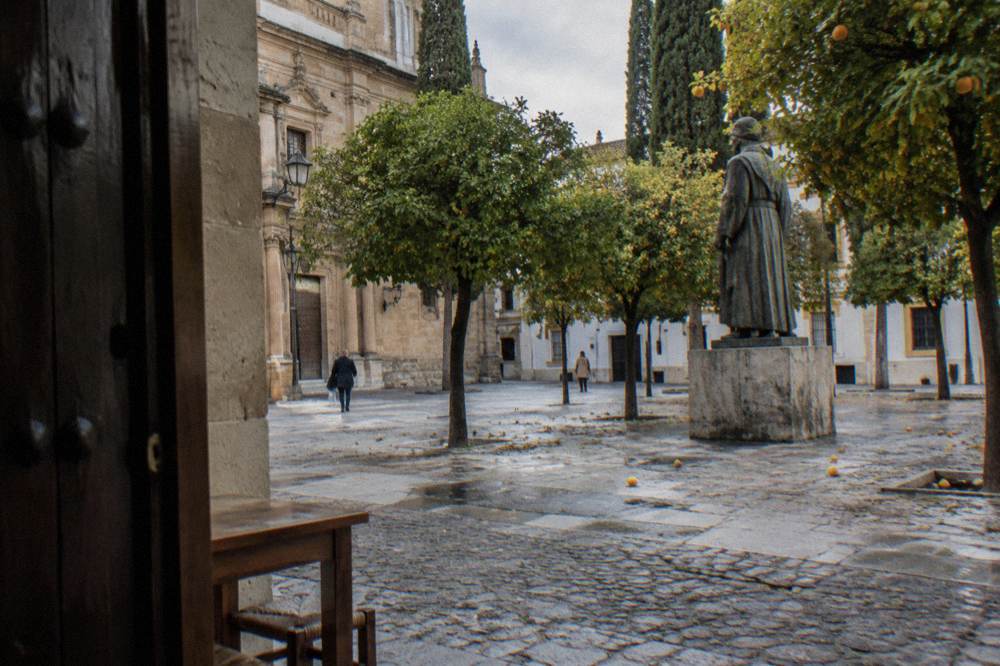
The Juderia setting is the reason the visit works as a walk rather than a trip. Plaza de Maimonides and Plaza de Judios sit essentially at the Synagogue's doorstep, both free public space, and the street network around them, including the Calleja de las Flores, is open around the clock. A route that starts at Puerta de Almodovar, follows the walls and the lane toward Plaza de Maimonides, visits the Synagogue, then loops through the Calleja de las Flores, covers the densest cluster of free public space in the city in under an hour of walking.
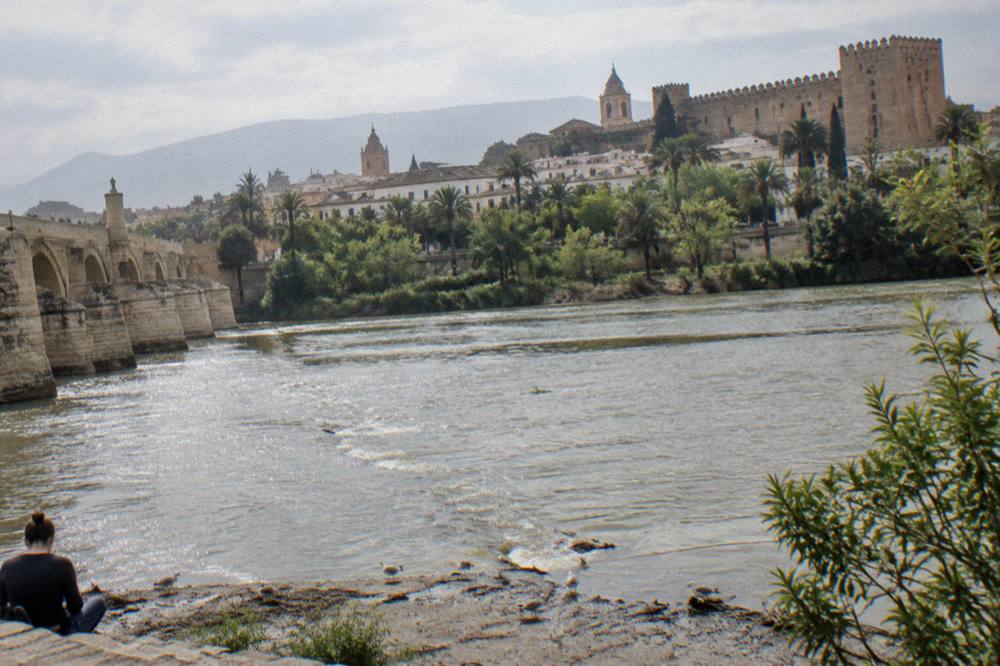
The approach from the river side is equally direct. The Puente Romano and the riverbank are free public space, and the Mirador de la Calahorra on the south bank is the standard viewpoint over the bridge and the Mezquita's skyline. From the bridge, the Puerta del Puente and the Triunfo de San Rafael stand at the edge of the old town, and the Juderia lies a short walk inland from there. The guide to the Roman Bridge and the Calahorra viewpoint covers that side of the river in full.
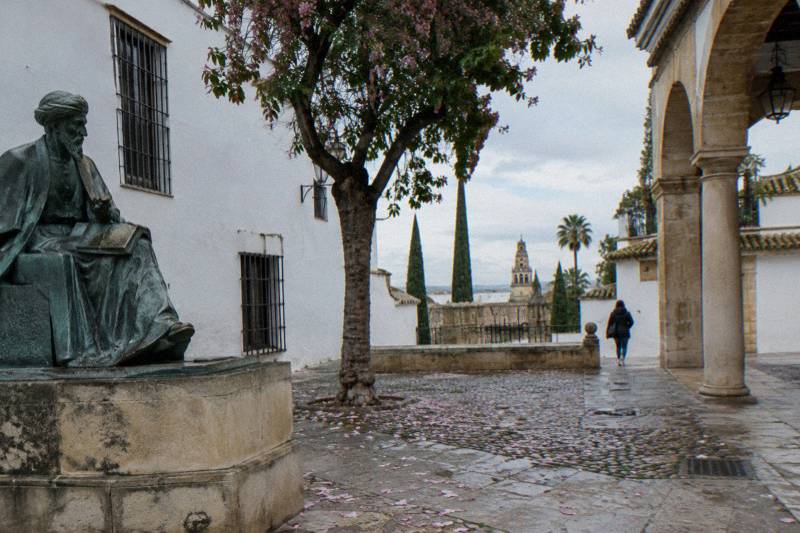
Meeting points matter here too, because several free walks gather within this same footprint. Walks meet at Puerta de Almodovar, at the Statue of Averroes by the gate, and at Plaza de las Tendillas a little further out, all of which are free public squares and streets where nothing is charged for being there. A visitor can plan an entire day in which the Synagogue's EUR 0.30, for non-EU citizens, is the only money handed over for anything with a door.
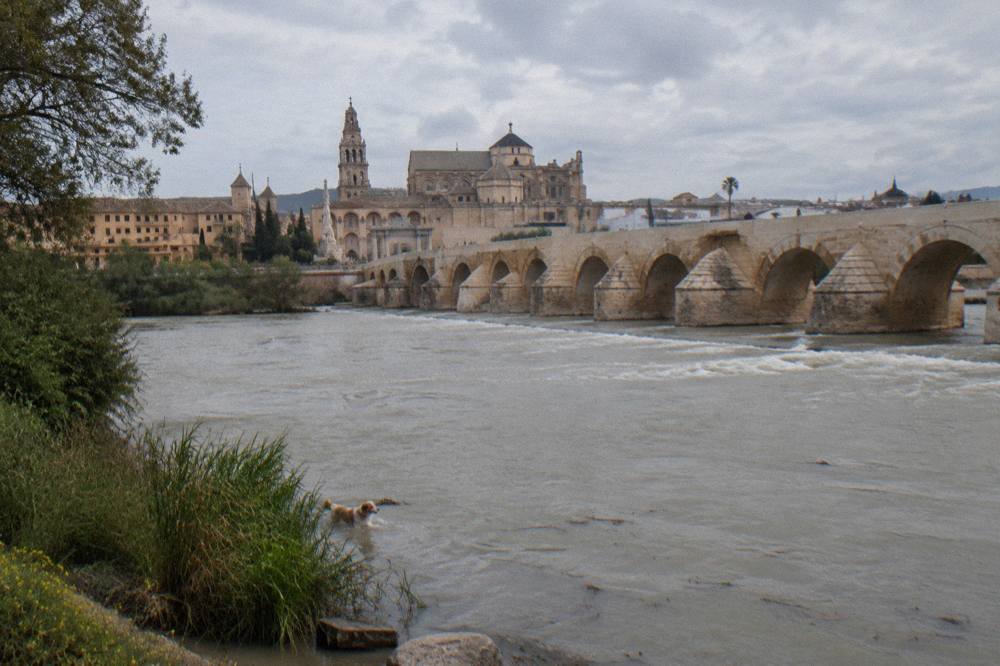
That framing is the honest one for this neighbourhood. The Juderia is dense with things that cost money, including Palacio de Viana's patios at EUR 8.50 and the unresolved house-museums mentioned earlier, but its skeleton, the streets, the walls, the plazas and the bridge approach, is entirely free. The Synagogue, at thirty cents or nothing, sits comfortably on the free side of that line.
Which Free Walking Tours Meet Nearby?
The Jewish Quarter Tour in English, listed on GuruWalk and run by the operator CORDOBA, meets at Puerta de Almodovar, the gate at the edge of the Juderia, and runs about 1 hour 30 minutes in English on a pay what you want basis. It is rated 4.46 out of 5 from 28 reviews on its GuruWalk listing, and its meeting point is a short walk from the Synagogue door.
That walk, the Jewish Quarter Tour in English, is the natural companion to a Synagogue visit, because the meeting point at Puerta de Almodovar stands at the top of the same street network the Synagogue sits inside. No Cordoba walk on the roster has a verified route beyond its meeting point and neighbourhood, so the honest description stops there: an English-language, pay what you want walk through the Jewish Quarter category, gathering at the Almodovar gate. Guiding is free in the pay what you want sense; the Synagogue's own entry rule, free for EU citizens or EUR 0.30 otherwise, is separate and unchanged.
A second English option meets on the same side of the old town. The 2 Hour Small-Group English Tour, run by Jose Manuel on GuruWalk, gathers at the Statue of Averroes at Puerta de Almodovar and runs 2 hours in English, rated 4.88 out of 5 from 354 reviews. Its small-group format is the appeal: the listing caps the group, which suits visitors who want to ask questions in a city where the big free walks draw crowds.
Beyond those, the roster's other English walks meet at points a little further afield but still within the walkable old town: Plaza de las Tendillas for the Heritage and World Heritage walks, Plaza del Triunfo by the Mezquita for the English Heritage Free Tour, and the Roman Temple on Calle Capitulares for the Best Of Free Tour, which carries 4.94 out of 5 from 3,732 reviews on GuruWalk. Spanish-language walks cover the same ground, including patio-focused options that carry additional costs on their listings for patio entry, so the language filter on each listing matters when choosing.
A note on how these walks relate to the Synagogue itself: no free walk on the roster includes monument entry, and none carries a price against it. Free means the guiding is pay what you want; every door, including the Synagogue's own EUR 0.30 rule for non-EU citizens, is the visitor's to settle. The free walking tours overview unpacks the pay what you want model, and the tipping question, in detail.
Mistakes That Trip People Up At The Synagogue
The recurring mistakes are assuming a Thursday free window exists here, expecting a free visit on a Monday, and confusing the Synagogue's nationality rule with the Mezquita's time-slot rule. Visitors also plan around Casa Andalusi and Casa de Sefarad as if they were free or priced, when neither has a published entry rule, and they arrive after 15:00 expecting an afternoon monument. Each error comes from merging this building with a different free scheme in the city.
The Thursday mistake is the most common. The municipal Thursday window, free for everyone in the last two hours at the Alcazar, the Banos Califales, the Julio Romero de Torres, the Taurino and the Fosforito, does not extend to Junta-run monuments. The Synagogue is Junta-run. On a Thursday afternoon it charges non-EU visitors EUR 0.30 exactly as it would on a Wednesday morning, and EU citizens walk in free exactly as they would any other open day. Treating Thursday as a special day here changes nothing.
The Monday mistake is simpler and more costly, because on Mondays there is nothing to enter at all. The building closes weekly, and a Juderia itinerary built for a Monday needs the streets, the walls and the plazas, not the interior. The 15:00 close is the other scheduling trap: this is a morning monument in practice, whatever the season.
The Mezquita confusion runs the other way. Visitors who learn the Mezquita's free slot, Monday to Saturday 8:30 to 9:30, individual visitors only, sometimes assume the Synagogue needs the same early start. It does not. Its free rule attaches to the visitor, not the clock, and it applies whenever the door is open. The two buildings, five minutes apart, run on entirely different free logic, and holding both rules in one day is the real test of a Cordoba itinerary.
Finally, the unresolved neighbours. Itineraries copied from older guidebooks often list Casa Andalusí and Casa de Sefarad alongside the Synagogue with confident prices attached. No such price is verified, and this site will not print one in either direction. Visit the Synagogue on its known terms, enjoy the streets for free, and treat the two house-museums as check-at-the-door questions rather than planned line items.
For anyone mapping the rest of the city's free rules, the Cordoba on a budget guide pulls every verified free and conditional entry into one place.
Common Questions About The Cordoba Synagogue
Is The Synagogue In Cordoba Free?
For accredited EU citizens, yes, on every open day. For everyone else, including UK and US visitors, entry costs EUR 0.30. The rule is a nationality rule set by the Junta de Andalucia, not a day or time-slot rule, and it applies Tuesday to Sunday from 9:00 to 15:00.
Which museums in Cordoba are free for EU citizens?
The Junta de Andalucia group: the Sinagoga, Medina Azahara, the Museo Arqueologico y Etnologico and the Museo de Bellas Artes. Entry is free on every open day for accredited EU citizens. Non-EU visitors pay EUR 0.30 at the Synagogue and up to EUR 1.50 at Medina Azahara.
Is the Synagogue free on Thursdays like the municipal museums?
No. The Thursday free window belongs to the city's own museums, such as the Alcazar de los Reyes Cristianos and the Julio Romero de Torres. The Synagogue is run by the Junta de Andalucia, so its free entry depends on EU citizenship and applies all day, not in a special Thursday slot.
What are the Cordoba Synagogue opening hours?
Tuesday to Sunday, 9:00 to 15:00. It is closed on Mondays. The 15:00 close makes it a morning stop in practice, and holiday-week schedules should be confirmed on the Junta's cultural agenda before a visit near a public holiday.
Can a free walking tour include the Synagogue inside?
No walk on this site's roster includes monument entry. Free walks are pay what you want for the guiding only, and every entrance remains the visitor's own arrangement. The Jewish Quarter Tour in English meets at Puerta de Almodovar, near the Synagogue, but entry follows the standard EU-citizen or EUR 0.30 rule.
Are Casa Andalusi and Casa de Sefarad free too?
Neither has a verified price or free rule, so this site publishes no entry claim for either. They may charge, or they may not; the honest advice is to ask at their doors. The streets around them, including Calle Judios and Plaza de Maimonides, are free public space with no ticket at all.